
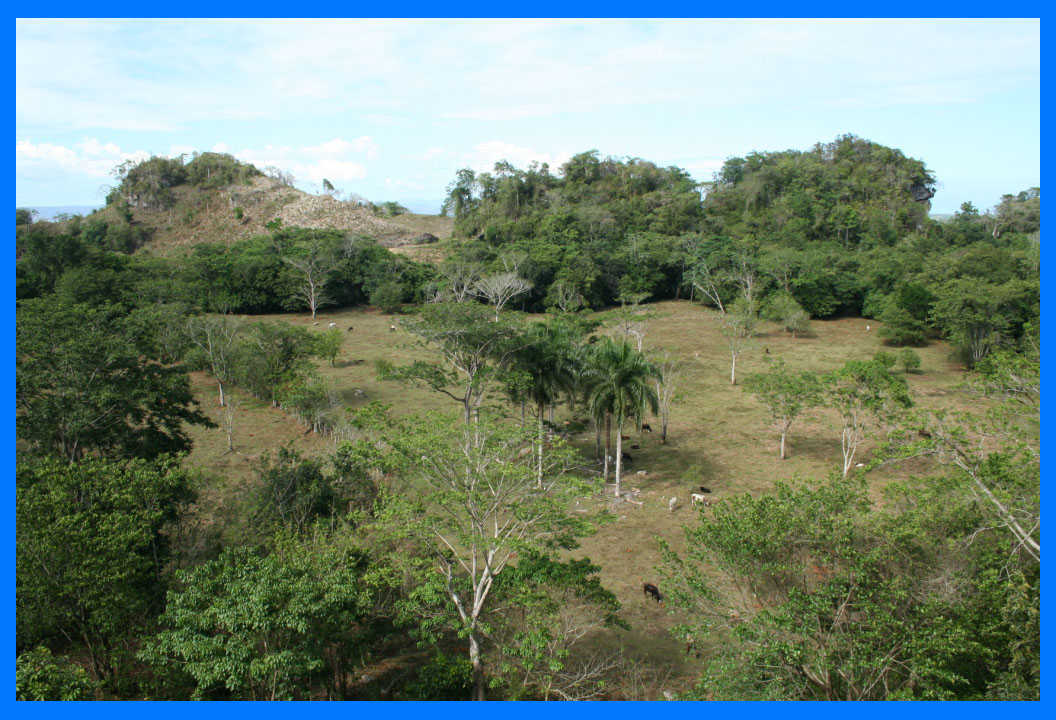
The survey
Data collection is being done via a variety of field and laboratory techniques.
Questionnaires:
A questionnaire has been designed and used in order to address a number of pertinent questions to conservation. The questions primarily addresses the following areas and is being carried out in communities living in the vicinity of protected areas
- Level of awareness of the two species
- Perception of the two species
- Magnitude of potential threats
Historical data:
Dr. Sam Turvey has been leading on this front and collecting data from historical records and documents. This involves going through scientific and museum records in addition to a large volume of grey literature which includes old newspapers and other non peer reviewed documents. This should provide us with a baseline of the historical distribution of solenodon and hutia.
Opportunistic data:
We are collecting data of any evidence of presence of either species whenever we come across these. Sources for this type of data have been:
- Targeted surveys in forest fragments both within and outside protected areas
- Signs seen while travelling to standardised sample points (see below)
- People contacting us to inform us of dead or captured animals
- Reports of animals sighted and/or photographed
Standardised sampling:
Standardised field methods are being used in order to establish the present day distribution of both solenodon and hutia along with data suitable for modelling their association with certain habitats and/or landscape characteristics.
Two different stratified random sampling approaches have had to be used because of the very different features present in the protected areas we have been working in. Sierra de Bahoruco national park is in a mountainous area so sampling has been stratified according to altitude with random sampling points divided across 400m altitudinal bands (see map)
Both Jaragua national park and del Este national park are in lowland areas and stratified sampling will be according to vegetation type.
Surveys at each of the randomly generated points are done in a standardised manner which combined looking for signs of both of the species we are concerned with in addition to taking a variety of habitat measures into place.
Looking for signs of the species:
We spend 20 minutes searching for sites of solenodon and hutia within the area.
Solenodon: Although we do occasionally find tracks of solenodon (top photo) the common sign of their presence in an area is what we have termed “nose pokes” (bottom photo). These are small conical holes in the soil which the solenodon has dug out in order to look for food (primarily insects and other invertebrates). These nose pokes are very distinctive and easy to spot.
The third sign that we look for is solenodon dung. This can be confused with other dung such as cat or even mongoose dung although it can be distinguished from both. Cat dung is generally buried or part buried and has a distinctive pointed ends shape whereas solenodon dung is generally found on the surface of the ground or quite often on fallen logs or on top of rocks and has blunt ends. It can be mistaken with mongoose dung although there are several characteristics that are typical of solenodon dung. Solenodon dung carries the very distinctive “goat like” smell of the species and in addition it typically has a very large proportion of chitinous millipede body ring sections. Mongoose dung is usually more pungent and although it may also contain chitinous arthropod sections these are mainly of beetles.
We also look for the solenodon warrens which are typically in small limestone caves but maybe in tree cavities or large fallen logs. The entrance is first examined to see if they are active, if there are spider webs across the entrance it is unlikely to be in current use. In addition to the lack of anything blocking the entrance there is normally the strong “goat” smell associated with solenodon. Further evidence includes small paths leading up to the entrance, dirt marks (often from iron oxide soils) in the cave entrance and small scratch marks from the solenodon claws on the surface of rocks or vegetation at the entrance.
Hutia: The signs that we look for to detect the presence of hutia are evidence of feeding (fruit, bark and leaves) along with the very distinctive hutia dung. Hutia dung pellets are about 1cm long with a slight curvature and tapered ends, additionally there is generally a darker coloured band running along the outer edge of the pellets.
Hutia also use similar type of dens to solenodon. They are distinguishable from the former because they typically have dung near the entrance, they have a different smell and very often you find trees or thick climbers nearby which have dirt and scratch marks left by hutia as they climb up them to reach the canopy. Habitat measures
A range of different habitat measures are being taken at each standardised sampling point.
On arrival at the point a GPS point is recorded. A 20m rope is extended from the centre in one direction. This rope has a marker every 2m. A 2.5 meter pole with 50cm sections marked off is placed at each marker along the rope. The first thing that is recorded is whether the pole is touching rock, soil, live plant material (e.g. root), dead plant material (e.g. log) or water – effectively a measure of rockiness. A 28cm spike is then inserted into the ground at a point within a 1cm circumference of where the pole touches the ground. The depth the metal spike reaches is then measured – a measure of soil depth. The number of vegetation touches by non grass species is recorded in each of the five 50cm sections along the length of the pole – a measure of vegetation density and heterogeneity (in other words degree of vegetation thickness and how this varies with distance from the ground).
This same process is repeated three further times with the rope extended at 90 degrees from the previous position – in other words four perpendicular lengths of rope. This gives a total of 20 measures per plot to give us a relative degree of rockiness and soil depth. This also gives us 20 measures of vegetation density at each of the five sections at different distance from the ground.
Canopy openness is measured using a canopy scope as developed by Brown et al. (2000). This is constructed of a clear CD case with 25 evenly spaced black dots drawn on it. The scope is held up vertically 20cm and the number of dots falling on light is counted. This is done 4 times per plot – 10m from the centre, half way along the length of rope used for the measures previously described. The ten trees closest to the centre of the plot with a circumference above 10cm are first identified into one of four classes (conifer, broadleaved, palm or tree fern) and its circumference at breast height recorded. A vernacular (common) name is also recorded where possible along with a note as to whether the tree is alive or dead. This will provide us with a measure in order to classify the forest type and relative biomass.
Genetic samples, morphology and confirmation of animal presence:
Whenever time allows and conditions permit we have been capturing animals in order to take genetic samples by removing a small amount of hair with hair follicles attached. This has been done both to animals caught by us or animals trapped by others and reported to us.
Genetic samples are also being taken from museum specimens held at various collections across the world in order to get a historical perspective on the genetic aspect of both species.
Camera trapping – we have been using Moultrie i60 infrared cameras placed strategically in order to confirm presence of solenodon and hutia. This has enabled us to obtain video footage and still photographs of animals (both target and non-target species). Still photographs, taken along with the video, record both the date and time along with ambient temperature and pressure
Distribution models
The information gathered in this way along with other information available such as population density, geology of an area, distance to nearest village/road/river will enable us to create a model. This model will then predict where we might expect the species to be found. This process will be a dynamic and on going one as further refinement is likely to be needed.


